
Article: How To Sleep Better: Sleep Starts in the Morning

How To Sleep Better: Sleep Starts in the Morning
How to Set Up Your Brain for Better Sleep
Summary:
Better sleep doesn't begin at bedtime. It begins in the morning, with the signals you give your brain throughout the day. From morning daylight and circadian timing to amino acids, breathwork and a greater sense of safety, discover how to create the conditions for deeper, more restorative sleep and why Calm Me has won the Best Supplement for Sleep & Recovery by the Nourish Awards in both 2025 and 2026. (Montgomery and Evelyn)
What if better sleep doesn't begin at bedtime?
Unpopular opinion: it is not just your night time sleep hygiene that helps you sleep.
If you're struggling to sleep, it's natural to focus on the final few hours of the day. Your evening routine, your phone, your bedroom, your caffeine, your bedtime.
But sleep is not something your brain simply switches on when you get into bed.
Your brain spends the whole day receiving signals about when to be awake, when to be alert, when to recover and when it is safe to let go.
Light. Movement. Nutrition. Stress. Breathing. Connection. Your sense of safety.
All of these can influence the state your brain and body are in by the time you go to sleep.
So rather than thinking about sleep as something you try to make happen at night, it can be more useful to think about setting your brain up for sleep from first thing in the morning and throughout the day.
This is particularly relevant if you recognise the feeling of being tired but wired, physically exhausted, but mentally alert and unable to properly switch off.
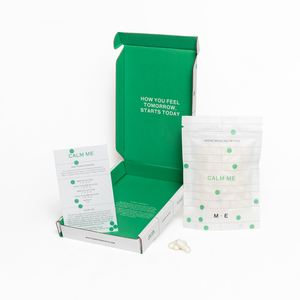
It is also the thinking behind Calm Me, our brain and nervous-system formula, which has won the Best Supplement for Sleep & Recovery at the Nourish Awards in both 2025 and 2026.

Key Takeaways
-
Morning daylight gives your brain an important signal for regulating your circadian rhythm and sleep–wake timing.
-
Glycine and L-theanine are amino acids with emerging research supporting aspects of sleep quality and recovery.
-
Slow breathing can influence autonomic nervous-system regulation and may help the body move towards a calmer state.
-
Hypervigilance can keep the brain alert and scanning for possible threat, making it harder to fully relax and sleep.
-
Sleep is built throughout the day, rather than created by one perfect bedtime routine.

1. Can Morning Daylight Help You Sleep Better?
Give your brain a clear signal that the day has begun
One of the simplest ways to support better sleep is to get outside into natural daylight as soon as you can after waking.
This isn't just about getting some fresh air.
Light is one of the strongest environmental signals your brain uses to regulate your circadian rhythm, your internal 24-hour clock.
Your circadian system helps coordinate daily rhythms including alertness, sleepiness and the timing of melatonin production.
Research suggests that the timing and intensity of light exposure can influence the timing of the sleep–wake cycle. A systematic review of 45 studies found that brighter morning light was associated with shifts towards earlier sleep timing and improvements in some subjective sleep measures. (PubMed)
A 2023 systematic review and meta-analysis of 22 studies involving 685 participants also found that light therapy had some beneficial effects on sleep maintenance in insomnia, with morning exposure tending to advance sleep–wake rhythms. The researchers noted that the studies were heterogeneous and that more research is needed to determine the most effective light exposure for different sleep problems. (PubMed)
So think of morning light as setting the clock for the day ahead.
Instead of:
Wake up → phone → emails → coffee → indoors
Try:
Wake up → curtains open → daylight → movement → start your day.
Sit by the brightest window.
Take yourself outside.
Have your tea or coffee in the garden.
Walk around the block.
You don't need to turn it into another wellness task.
You're simply giving your brain some useful information:
It's morning.
It's time to be awake.
The day has started.
And that clearer distinction between biological day and night can help create better conditions for sleep later.

2. Can Glycine and L-Theanine Support Sleep?
Give your brain the nutritional building blocks it needs
Sleep isn't only about your hormones or nervous system.
Your brain also needs the right nutritional building blocks to function normally.
This is one reason amino acids are interesting when we think about sleep.
Two amino acids with emerging research in this area are glycine and L-theanine.
Glycine and sleep
Glycine is an amino acid involved in a wide range of processes throughout the body and brain.
Human studies have investigated its potential role in sleep.
One placebo-controlled study found that 3 g of glycine taken before bedtime improved subjective sleep quality and sleep efficiency in people experiencing poor sleep.
Another study found that glycine supplementation reduced next-day fatigue and sleepiness following short-term sleep restriction. (PubMed)
So glycine isn't a magic sleep ingredient.
It is an example of something much more useful:
The nutritional environment of the brain matters.
L-Theanine and sleep
L-theanine is another amino acid that has attracted considerable interest.
Rather than simply acting as a sedative, L-theanine is being studied for its potential to support relaxation and sleep quality.
A 2025 systematic review and meta-analysis included 19 studies involving 897 participants. The researchers found significant improvements in subjective sleep-onset latency, daytime dysfunction and overall subjective sleep quality. They also noted that more research is needed to establish optimal doses and durations. (PubMed)
A further systematic review published in 2026 identified 13 trials involving 550 participants, including 11 randomised controlled trials. The studies reported benefits across measures including sleep latency, sleep maintenance, sleep efficiency, sleep satisfaction and feelings of refreshment and recovery on waking. The researchers also called for further high-quality research. (PubMed)
That's particularly interesting because good sleep isn't simply about making your brain tired.
Sometimes the problem is that your brain is too alert to transition easily into sleep.
Which brings us to the nervous system.

3. Can Breathing Exercises Help With Stress and Sleep?
Practice moving from activation towards recovery
Your breathing is unusual because it is both automatic and consciously controllable.
That makes it the most useful tool to help influence your state in the moment.
When you're stressed, rushed or anxious, your breathing can become faster, shallower or more effortful.
Slowing it down gives your body a different signal.
Research suggests that slow breathing can influence autonomic nervous-system activity, including measures associated with parasympathetic and sympathetic regulation. A 2026 systematic review of nine studies involving 457 participants found improvements in self-reported sleep duration and sleep quality following slow breathing, although findings from objective sleep measurements were inconclusive. (PubMed)
This doesn't mean that breathing is a cure for insomnia.
The more useful way to think about it is:
Breathing gives you a simple way to practice changing state.
From:
activation → regulation
From:
tension → recovery
From:
“I need to deal with everything” → “I can pause.”
That matters because GABA is one of the brain's main inhibitory neurotransmitters, often described as the brain's natural brake.
Breathing isn't a substitute for nutritional support of GABA pathways.
But learning to move your body out of a heightened state gives you another tool for supporting nervous-system regulation.
What breathing exercises can you do during the day?
You don't have to spend 20 minutes meditating every morning.
Instead, practice short periods of slower breathing throughout the day.
Try a longer-exhale breath
Inhale gently for 4 seconds.
Exhale slowly for 6 seconds.
Repeat for 2–5 minutes.
Don't force the breath.
Don't take huge breaths.
Keep it comfortable.
The longer exhale isn't a magic formula. It simply gives you an easy structure for slowing your breathing and creating a deliberate pause.
Try it:
-
Before opening your emails
-
Between meetings
-
In the car
-
After a stressful conversation
-
When you notice your shoulders rising
-
When your thoughts start racing
-
Before moving from work into the rest of your day
You can also use a physiological sigh when you feel a sudden spike of stress:
Take a gentle inhale.
Then take a second, smaller inhale.
Then slowly breathe out.
Repeat once or twice.
Or use the simplest version of all:
Stop.
Breathe in gently.
Breathe out slowly.
Repeat.
The aim isn't to spend your whole day doing breathwork.
It's to practice changing state.

4. Can Hypervigilance Affect Your Sleep?
Sometimes your brain needs to feel safe enough to let go
This may be one of the most important pieces of the sleep puzzle.
Because sometimes poor sleep isn't simply because you don't know how to relax.
Sometimes your brain doesn't fully believe that it is safe to relax.
We often think of safety as meaning that nothing bad is happening.
But psychologically, safety can be much more subtle.
Your brain is constantly asking:
What do I need to watch out for?
What might happen?
What have I missed?
Who might be upset?
What could go wrong?
What do I need to prepare for?
What happens if I let my guard down?
This is where hypervigilance can become important.
Hypervigilance means being unusually alert to possible threat.
It can develop after experiences where staying alert was genuinely useful including trauma, prolonged conflict, unpredictable relationships, bullying, chronic stress, illness, caregiving, grief or major life changes.
Sometimes the original situation has ended.
But the habit of watching can remain.
You may no longer consciously feel frightened.
You may simply find that you:
-
Notice every noise
-
Check your phone repeatedly
-
Scan other people's moods
-
Anticipate problems
-
Rehearse conversations
-
Feel responsible for keeping everything under control
-
Wake easily
-
Find it difficult to completely let go
Your nervous system isn't necessarily malfunctioning.
It may have learned to protect you by staying ready.
And sleep requires something rather different.
It requires you to surrender a certain amount of control.
Research has particularly linked hyperarousal and hypervigilance with sleep disturbance in people experiencing trauma-related symptoms and PTSD. Studies have also found associations between fear of sleep, hypervigilance and greater sleep disturbance. (PubMed)
That doesn't mean everyone with poor sleep is hypervigilant.
But if you recognise yourself in this pattern, it may be worth asking a different question.

What if the question isn't “How do I switch off?”
Instead ask:
“What signals can I give my brain during the day that tell it I don't need to be on guard all the time?”
This isn't about convincing yourself that everything is perfect.
It's about helping your brain distinguish between:
Something is happening.
and
Something dangerous is happening.
Those aren't the same thing.
Practice this safety dialogue during the day
When you notice yourself scanning, worrying or preparing for something that hasn't happened, pause.
Put your feet on the floor.
Take one slow breath.
Then say:
“I notice that I'm looking for what might go wrong. My brain is trying to protect me. But right now, in this moment, I am safe enough. I don't need to solve everything right now. I can notice what is actually happening rather than preparing for what might happen.”
Then ask yourself:
What is actually happening right now?
Not:
What if...?
Not:
What might...?
Not:
What happened last time...?
But:
What is happening now?
This is a shift from threat anticipation to present-moment information.
Practice it when you're:
-
Sitting at your desk
-
Driving
-
Making lunch
-
Waiting for a reply
-
About to have a difficult conversation
-
Feeling the urge to check
-
Rehearsing something that hasn't happened
-
Preparing for every possible outcome
The goal isn't to tell yourself that there is never anything to worry about.
It's to give your brain opportunities to experience:
I don't have to be on guard every second.

Sleep Is Built Throughout the Day
Better sleep isn't one perfect bedtime routine.
It's the result of the signals your brain receives throughout the day.
Morning daylight helps give your circadian system a clear signal that the day has begun.
Movement and daytime activity provide further information about wakefulness and recovery.
Nutrition and amino acids provide the building blocks your brain needs for normal function.
Breathing gives you a practical way to practice moving from activation towards recovery.
Connection and positive experiences remind your brain that life isn't only about demands and problems.
And moments of safety give your nervous system opportunities to stop scanning and simply be present.
By the time you get into bed, you're not starting from scratch.
You've been setting up sleep all day.
Where Does Calm Me Fit In?
This is the thinking behind Calm Me.
Calm Me isn't designed simply to make you sleepy.
It's formulated around calm, nervous-system support and sleep, combining amino acids including L-theanine, L-glutamine and glycine, alongside three forms of magnesium and activated B vitamins.
The aim is to provide nutritional support for pathways involved in calm, relaxation and normal nervous-system function helping to provide you with the nutritional foundation for a brain that needs to move between activation and recovery.
Calm Me has won awards for the Best Supplement for Sleep & Recovery at the Nourish Awards in both 2025 and 2026, reflecting the formula's focus on nutritional support for calm, sleep and recovery.
Calm Me → Support your calm + sleep
If your version of poor sleep sounds like:
“I'm exhausted but I can't switch off.”
“My mind keeps running.”
“I wake up feeling like I haven't properly recovered.”
“I'm tired all day but somehow still alert.”
Then it may be worth looking at the whole picture - light, nervous-system regulation, nutrition, breathing and your sense of safety - rather than simply looking for something to knock you out.
Good sleep isn't something you force.
It's something you set your brain up for.
BETTER SLEEP → MORNING LIGHT → CIRCADIAN RHYTHM → AMINO ACIDS → GLYCINE + L-THEANINE → BREATHING → AUTONOMIC REGULATION → HYPERVIGILANCE → SAFETY → NERVOUS SYSTEM → CALM ME → SLEEP & RECOVERY
Start in the morning. Build throughout the day. Let sleep come from there.

Frequently Asked Questions
Does morning sunlight help you sleep better?
Morning light is an important environmental cue for the circadian system. Research suggests that appropriately timed morning light can influence sleep–wake timing and may improve some aspects of sleep. (PubMed)
Does glycine help with sleep?
Human studies suggest that glycine may improve aspects of subjective sleep quality and sleep efficiency, and may reduce next-day fatigue following short-term sleep restriction. However, the evidence base remains relatively small.
Does L-theanine help you sleep?
Emerging evidence suggests that L-theanine may support aspects of sleep quality, sleep onset and daytime functioning. A 2025 systematic review and meta-analysis found improvements in several subjective sleep measures, while a 2026 systematic review reported benefits across a broader range of sleep outcomes. More high-quality research is still needed. (PubMed)
Can breathing exercises improve sleep?
Research suggests that slow breathing can influence autonomic nervous-system regulation and may improve self-reported sleep quality and duration. However, evidence from objective measures of sleep remains less conclusive. (PubMed)
Does breathing increase GABA?
There isn't enough evidence to make a strong claim that a particular breathing exercise directly increases brain GABA in humans. A more evidence-based explanation is that slow breathing can influence autonomic regulation and help support a shift towards a calmer physiological state.
Can anxiety and hypervigilance affect sleep?
Yes. Particularly in trauma-related stress, heightened arousal and hypervigilance can contribute to difficulties falling asleep, staying asleep and feeling rested. (PubMed)
Why am I tired but unable to sleep?
Feeling exhausted while remaining mentally alert can have many possible causes, including stress, anxiety, circadian disruption, sleep disorders, medication, physical health conditions and other factors. Persistent or significant sleep problems should be discussed with a healthcare professional.
What Does the Research Tell Us?
The evidence isn't equally strong for everything discussed here.
The science behind circadian rhythms and light exposure is well established, while research into glycine, L-theanine and slow breathing is promising but still developing.
We believe it's important to make that distinction.
These approaches may support the conditions associated with healthy sleep, but no individual ingredient, breathing technique or lifestyle practice can guarantee better sleep or treat insomnia on its own.
If you have persistent insomnia, significant daytime sleepiness, loud snoring or breathing pauses during sleep, or sleep problems that are affecting your mental or physical health, speak to your GP or an appropriate healthcare professional.
Further Reading
You may also be interested in:
Reasons You're Always So Tired: Your Nervous System Reset
Calm Me — nutritional support for calm, sleep and recovery
Research References
As featured in this story

Written by Evelyn Montgomery


Leave a comment
This site is protected by hCaptcha and the hCaptcha Privacy Policy and Terms of Service apply.