

Is Taking Glutamine Before Bed a Good Idea? What You Need to Know
Can you take glutamine before bed? Does L-glutamine help with sleep? And what does glutamine have to do with GABA and a racing mind?
If you feel tired but wired at night? Physically exhausted but mentally unable to switch off? You may have come across L-glutamine as a possible nutritional support for sleep.
Glutamine is one of the body's most abundant amino acids and plays important roles in metabolism, the gut and immune system. It is also involved in the pathways that produce the neurotransmitters glutamate and GABA.
But does that mean taking glutamine before bed will help you sleep?
The short answer is: it may be useful as part of a broader nutritional approach, but glutamine isn't a proven sleep treatment and the evidence specifically for taking glutamine before bed is limited.
What makes the subject interesting is the relationship between glutamine, glutamate and GABA and the way these pathways interact with the brain and nervous system.

SUMMARY:
GLUTAMINE BEFORE BED: WHAT DO YOU NEED TO KNOW?
If you're considering taking L-glutamine before bed, here's the important bit:
-
Glutamine is an amino acid that the body naturally produces and also obtains from protein-containing foods.
-
It has important roles in metabolism, gut function, immune function and neurotransmitter pathways.
-
Glutamine is involved in the production of glutamate and GABA, two important neurotransmitters with different roles in the nervous system.
-
GABA is an inhibitory neurotransmitter involved in regulating neuronal activity and is associated with relaxation and sleep physiology.
-
However, taking glutamine does not simply mean that more glutamine automatically equals more GABA or better sleep.
-
Research specifically investigating glutamine as a sleep supplement in healthy people is limited.
-
If your main problem is a busy mind, difficulty relaxing or feeling overwhelmed at bedtime, it may make more sense to look at your overall nutritional and lifestyle support rather than focusing on one ingredient.
-
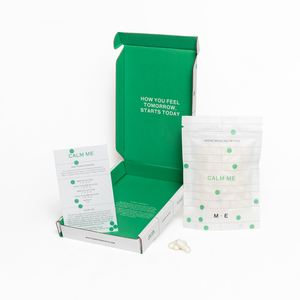
This is the thinking behind Calm Me, which combines L-glutamine with L-theanine, magnesium, glycine, taurine, vitamin B6, vitamin D3 and probiotics.
So yes, glutamine can be taken in the evening, but the bigger question is what you are trying to support and what else is in your nutritional routine.

WHAT IS L-GLUTAMINE?
Glutamine is an amino acid that occurs naturally in the body.
It is also found in protein-containing foods including meat, fish, eggs, dairy products, beans and other protein-rich foods.
Your body can make glutamine itself, which is why it is classified as a conditionally essential amino acid rather than an essential amino acid under normal circumstances.
Glutamine is involved in a wide range of biological processes.
It contributes to:
-
protein metabolism
-
nitrogen transport
-
intestinal cell function
-
immune-cell metabolism
-
energy metabolism
-
neurotransmitter metabolism
It is therefore much more than a “sports supplement”.
Glutamine has traditionally been popular in the fitness world because of its relationship with muscle and recovery, but its biology is much broader.
One particularly interesting area is the brain-gut connection.

WHAT DOES GLUTAMINE HAVE TO DO WITH THE BRAIN?
Glutamine is involved in the brain's neurotransmitter system.
One of its important roles is as part of the glutamate–glutamine cycle, which helps regulate the supply and recycling of glutamate and glutamine between neurons and glial cells.
Glutamate and GABA are closely connected within brain metabolism.
Glutamate is the brain's major excitatory neurotransmitter, while GABA is the major inhibitory neurotransmitter.
That balance matters.
Too much neuronal excitation isn't what you want when you're trying to wind down for sleep.
GABA, meanwhile, acts as one of the brain's important inhibitory signalling systems, helping regulate neuronal activity.
This is why GABA is often described as part of the brain's “braking system.”
But there is an important distinction:
Glutamine is involved in the biochemical pathway. That doesn't mean taking glutamine automatically increases brain GABA to a level that will make you sleepy.
Human biology is more complicated than that.
GLUTAMINE, GABA AND SLEEP
This is where things get particularly interesting.
GABA is involved in the regulation of neuronal excitability and sleep.
The body naturally regulates its neurotransmitter systems through interconnected metabolic pathways.
Glutamine contributes to the production and recycling of glutamate, and glutamate can be converted into GABA.
So it is reasonable to be interested in the relationship between:
Glutamine → glutamate → GABA → nervous-system regulation
But this shouldn't be interpreted as:
Take glutamine → make more GABA → fall asleep.
The evidence doesn't support such a simple equation.
Sleep is influenced by multiple systems, including circadian rhythms, sleep pressure, hormones, neurotransmitters, stress, environment and behaviour.
That's why we think the most useful way to look at glutamine is as one nutritional building block within a much bigger picture.
WHY DO I FEEL TIRED BUT WIRED AT NIGHT?
This is one of the most common reasons people become interested in calming nutrients.
You're exhausted.
You know you need sleep.
But the moment your head hits the pillow, your brain seems to become more active.
You replay conversations.
You think about tomorrow.
You remember everything you forgot to do.
You start solving problems that didn't seem important at 3pm.
Your body is tired.
Your mind isn't.
Tired but wired.
This experience can have many causes.
Stress.
Anxiety.
Poor sleep habits.
Caffeine.
Alcohol.
Hormonal changes.
Irregular sleep schedules.
Too much stimulation late at night.
Pain or illness.
Or simply having a lot going on in your life.
Nutrients can form part of the picture, but persistent sleep problems shouldn't automatically be attributed to a nutritional deficiency.
CAN GLUTAMINE HELP A RACING MIND?
There is a biological reason why glutamine is interesting here: it participates in neurotransmitter metabolism, including pathways involving glutamate and GABA.
If your main problem is an overactive mind at bedtime, it may be more useful to think in terms of nervous-system support as a whole.
That could include:
Daytime movement
Regular movement can support sleep quality and help regulate stress.
Morning daylight
Getting natural light early in the day helps anchor the body's circadian rhythm.
Caffeine timing
If you're sensitive to caffeine, consuming it late in the day can interfere with sleep.
A calmer evening
Your brain needs a transition between “doing” and “sleeping”.
Breathing and relaxation
Slow breathing, meditation or simply taking a few minutes away from stimulation can help create a clearer boundary between the day and bedtime.
Nutrition
Adequate protein, essential nutrients and a balanced diet provide the raw materials the nervous system needs to function normally.
And this is where a combination of nutrients can be more interesting than focusing on one ingredient.

WHAT OTHER NUTRIENTS SUPPORT A CALMER EVENING?
Glutamine isn't the only nutritional ingredient involved in the pathways surrounding calm and sleep.
Several nutrients are particularly interesting.
L-theanine
L-theanine is an amino acid naturally found in green tea.
It is widely studied for its relationship with relaxation and attention, without being considered a conventional sedative.
Magnesium
Magnesium contributes to normal nervous-system and psychological function and to the reduction of tiredness and fatigue.
Different forms of magnesium are available, and absorption and tolerability can vary between forms.
Vitamin B6
Vitamin B6 contributes to normal psychological function and normal nervous-system function.
It is also involved in normal protein and glycogen metabolism and contributes to the regulation of hormonal activity.
Glycine
Glycine is an amino acid involved in neurotransmission and has been investigated in relation to sleep.
Probiotics
The gut and brain communicate through multiple pathways, often referred to collectively as the gut-brain axis.
This doesn't mean that taking a probiotic will automatically improve sleep, but it is one reason why gut health has become an increasingly interesting part of brain-health research.
WHY WE PUT GLUTAMINE INTO CALM ME
This is where Calm Me takes a different approach from a single-ingredient glutamine supplement.
Calm Me was designed for people who recognise that tired but wired feeling:
-
racing thoughts
-
feeling overwhelmed
-
difficulty switching off
-
mental tension
-
stressful days
-
unsettled nights
-
wanting support for relaxation and normal nervous-system function
Rather than relying on one ingredient, Calm Me combines a number of nutritional building blocks.
Inside Calm Me
L-Glutamine — 600 mg
Included as a key amino acid involved in brain and neurotransmitter metabolism.
L-Theanine — 200 mg
Included for nutritional support around relaxation, calm and focus.
Magnesium — 60 mg
Provided from three forms: bisglycinate, citrate and taurate. Magnesium contributes to normal nervous-system and psychological function and the reduction of tiredness and fatigue.
Glycine — 80 mg
An amino acid involved in neural signalling and investigated in relation to sleep.
Taurine — 80 mg
Included as part of the broader amino-acid profile supporting neurological balance.
Vitamin B6 — 40 mg
Contributes to normal psychological and nervous-system function.
Vitamin D3 — 25 mcg
Contributes to normal psychological and cognitive function.
Probiotic blend — 500 million live bacteria
A combination of bacterial strains and Saccharomyces boulardii included as part of the formulation's broader gut-brain approach.
Calm Me provides two capsules per daily serving and is vegan, gluten-free and made in Britain.
The formulation is designed around calm, relaxation, normal nervous-system function and sleep support, rather than treating sleep as an isolated problem. (Montgomery and Evelyn)
Could Calm Me be a better approach than taking glutamine alone?
If you're specifically interested in glutamine, you could certainly choose a standalone glutamine supplement.
But if what you're actually looking for is broader nutritional support for a busy mind, relaxation and your evening routine, Calm Me brings several complementary nutrients together in one formulation.
It's the difference between asking “What ingredient should I take?” and asking “What state am I trying to build?”
⭐️⭐️⭐️⭐️⭐️
“Thank You!
I have spent many years struggling with bad sleep but this has improved my sleep completely. It has taken me a little while to find the best time and dosage to get the best results.
I have finally found balance by taking one of these a few hours before bed and I am able to drift off easily. I am no longer tossing and turning until the early hours trying to fall asleep.
Since taking these I have also found that I am a lot calmer during my everyday activities. Things that would normally stress me out I am able to deal with in a calm way without becoming overwhelmed.
These are fantastic and I would recommend for people to try. I will buy more and I am intrigued by mood me to see if this would help other areas of my life too. Very happy, thank you!”
Harriet H. (Yopto verified review)

Find out more about CALM ME here ->
Independent Recognition for Calm Me
Calm Me has received three independent award recognitions for its approach to calm, relaxation and sleep support.
In 2024, Calm Me was selected as Best for Sleep in Red’s Better Perimenopause Awards, with the expert judging panel specifically highlighting its combination of three forms of magnesium and L-theanine. (Red Online)
In 2025, Calm Me won the Nourish Award for Sleep & Recovery, recognising the formulation within a category focused on sleep quality, relaxation and recovery. (Nourish Awards)
In 2026, Calm Me was recognised again by the Nourish Awards, winning a 2-Star Nourish Excellence in Sleep & Recovery. Nourish states that its supplement awards assess factors including formulation quality, active ingredients and bioavailability, synergistic combinations, appropriate dosing, scientific testing, innovation and overall product quality. (Nourish Awards)
For us, these awards are valuable not because an award can promise an individual outcome, but because they provide independent recognition of the formulation itself.
Calm Me was created as a multi-nutrient approach to calm and sleep, combining L-glutamine, L-theanine, magnesium, glycine, taurine, vitamin B6, vitamin D3 and probiotics and its recognition across different expert-led awards gives you another reason to consider what is actually inside.
Calm Me: award recognition over time
The three recognitions:
-
2024 — Red’s Better Perimenopause Awards: Best for Sleep. (Red Online)
-
2025 — Nourish Awards: 3-Star, Sleep & Recovery. (Nourish Awards)
-
2026 — Nourish Awards: 2-Star, Sleep & Recovery — Nourish Excellence. (Nourish Awards)
I would not turn the three awards into a single “score” because Red’s award and Nourish’s star system measure different things. The timeline is much more trustworthy and makes the repeated recognition visible without implying that a 2026 2-star result is somehow “worse” than a 2025 3-star result.
Calm Me award recognition
Three independent award recognitions received between 2024 and 2026.
| year | recognitions |
|---|---|
| 2024 | Winner - Red Best For Sleep |
| 2055 | Winner - Best for Sleep & Recovery |
| 2026 | Winner - Best for Sleep & Recovery |
WHEN IS THE BEST TIME TO TAKE GLUTAMINE?
There isn't a universally established “best” time to take glutamine for sleep because glutamine is not an established sleep treatment.
Some people choose to take it in the evening because they are interested in its role in neurotransmitter metabolism and want to incorporate it into a bedtime routine.
Others take glutamine at different times for nutritional or sports-related reasons.
If you're taking Calm Me, the recommended serving is two capsules per day. Because people respond differently to supplements, some prefer to incorporate their serving into their evening routine, while others may find another time works better for them.
Follow the product directions and speak with a healthcare professional if you're unsure about suitability.
GLUTAMINE BEFORE BED: WHAT ABOUT THE GUT?
Glutamine is also important in the gut.
Intestinal cells use glutamine as a fuel source, and glutamine has been studied extensively in relation to intestinal metabolism and gut barrier function.
However, that doesn't mean taking a glutamine supplement automatically “heals” the gut.
As with the brain, glutamine is one component of a complex biological system.
A healthy gut also depends on:
-
adequate fibre
-
varied plant foods
-
sufficient protein
-
hydration
-
healthy fats
-
regular meals
-
physical activity
-
sleep
-
overall dietary quality
This is another reason we like the idea of whole-body nutrition rather than single-ingredient thinking.
YOUR EVENING GABA TOOLKIT
If your problem is that your brain doesn't seem to know when the day is over, try building a simple evening routine around the nutrients and behaviours that support a calmer state.
1. Dim the stimulation
Reduce bright light and intense activity as bedtime approaches.
2. Take a walk
Gentle movement can help create a transition out of the working day.
3. Try slow breathing
A few minutes of slower, longer breaths can be a useful signal that it's time to shift gears.
4. Put the phone down
Not because your phone is “bad”, but because your brain needs fewer things competing for its attention.
5. Create a repeatable cue
Same mug.
Same music.
Same book.
Same lights.
Same time.
Your brain learns through repetition.
6. Support your nutritional foundations
A balanced diet provides the amino acids, vitamins and minerals needed for normal physiological function.
7. Build your state
The aim isn't to force yourself to sleep.
It's to create the conditions in which sleep can happen.
SO, IS TAKING GLUTAMINE BEFORE BED A GOOD IDEA?
It can be a reasonable part of an evening nutritional routine, but glutamine shouldn't be thought of as a guaranteed sleep aid.
Glutamine is an important amino acid involved in metabolism, gut function and neurotransmitter pathways.
Its relationship with glutamate and GABA makes it particularly interesting when we're thinking about the biology of the nervous system.
But sleep is complicated.
If you regularly struggle to sleep, wake repeatedly during the night, or experience persistent anxiety or exhaustion, it's worth looking beyond a single nutrient and considering the bigger picture.
And if you're looking for broader nutritional support for a busy mind and calmer evenings, Calm Me was specifically formulated around that goal.
Sometimes the answer isn't one more thing to take.
It's creating a better state for your brain to be in.
How well you sleep tonight starts today.
FREQUENTLY ASKED QUESTIONS
Can I take L-glutamine before bed?
Yes, glutamine can be taken in the evening, provided it is suitable for you and used according to the product's directions.
There is no universally established bedtime dose specifically for sleep, however, because glutamine is not an established treatment for insomnia.
Does glutamine help you sleep?
There is a biological rationale for interest in glutamine because it participates in pathways involving glutamate and GABA.
However, evidence that glutamine supplementation directly improves sleep in healthy people is limited.
It is better viewed as a nutritional amino acid involved in several biological processes than as a conventional sleep aid.
Does glutamine increase GABA?
Glutamine is involved in the metabolic pathway that produces and recycles glutamate and GABA.
However, this does not mean that taking glutamine automatically produces a predictable increase in brain GABA.
Neurotransmitter metabolism is tightly regulated and influenced by many factors.
What is the difference between glutamine and GABA?
Glutamine is an amino acid involved in protein metabolism, gut function, immune function and neurotransmitter metabolism.
GABA is a neurotransmitter — a chemical messenger used by the nervous system.
Glutamine participates in the biochemical pathways connected with glutamate and GABA, but they are not the same substance.
Is glutamine good for a racing mind?
Glutamine is involved in neurotransmitter metabolism, including pathways connected with GABA.
However, there is not enough evidence to describe glutamine as a treatment for racing thoughts or anxiety.
If a racing mind is interfering with sleep regularly, consider the wider picture — including stress, caffeine, sleep routine, mental health and overall nutrition.
Should I take glutamine in the morning or at night?
There is no single evidence-based answer for everyone.
The appropriate timing depends partly on why you are taking glutamine.
If you're taking it specifically as part of an evening routine, bedtime may be a convenient time, but it isn't established as a superior time for sleep.
What is the best supplement for a busy mind at night?
There isn't one supplement that is best for everyone.
Different nutrients have different roles, and persistent sleep problems can have many causes.
Calm Me combines L-glutamine, L-theanine, magnesium, glycine, taurine, vitamin B6, vitamin D3 and probiotics as a broader nutritional approach to calm, relaxation and normal nervous-system function.
Does Calm Me contain glutamine?
Yes.
Calm Me contains 600 mg of L-glutamine per daily serving, alongside 200 mg L-theanine, magnesium from three forms, glycine, taurine, vitamin B6, vitamin D3 and a probiotic blend. (Montgomery and Evelyn)
Is Calm Me just a glutamine supplement?
No.
Glutamine is one of the key ingredients, but Calm Me is a multi-nutrient formulation designed around calm, relaxation and normal nervous-system function.
The formulation combines amino acids, magnesium, vitamins and probiotics rather than relying on glutamine alone. (Montgomery and Evelyn)
Can I take Calm Me before bed?
Calm Me is designed for people looking for nutritional support around calm, relaxation and sleep, and many people incorporate it into an evening routine.
The product directions recommend two capsules per day.
If you are taking medication, are pregnant or breastfeeding, or are under medical supervision, check with your healthcare professional before taking it. (Montgomery and Evelyn)
Is glutamine safe to take every day?
Glutamine is naturally produced by the body and obtained from food, but whether supplementation is appropriate depends on the individual and the dose.
If you have a medical condition, are taking medication, are pregnant or breastfeeding, or are considering long-term supplementation, speak with an appropriate healthcare professional.
Can glutamine make you sleepy?
Glutamine is not a sedative and shouldn't be expected to make you sleepy in the way a conventional sleep medication might.
Its interest in sleep comes from its involvement in broader metabolic and neurotransmitter pathways rather than from a direct sedative effect.
What else can I do if I feel tired but wired at night?
Start with the basics:
-
Get daylight early in the day.
-
Move regularly.
-
Avoid excessive caffeine late in the day.
-
Eat enough nutritious food.
-
Give yourself a transition between work and bedtime.
-
Reduce stimulating activity in the evening.
-
Try slow breathing or another relaxation practice.
-
Keep your sleep and wake times reasonably consistent.
If sleep problems persist, seek professional advice rather than relying solely on supplements.
THE TAKEAWAY
Glutamine is a fascinating amino acid.
It is involved in the gut.
It is involved in metabolism.
It is involved in immune function.
And it participates in the pathways connecting glutamate and GABA in the nervous system.
But the brain isn't a simple “more glutamine = more GABA = better sleep” equation.
Your sleep is influenced by your whole state.
Your nutrition.
Your nervous system.
Your stress levels.
Your light exposure.
Your movement.
Your routines.
Your environment.
And your ability to switch from doing to resting.
That's why we created Calm Me as a combination rather than a single ingredient.
Glutamine is part of the story.
It isn't the whole story.
Build your state.
How well you sleep tonight starts today.
A note on the evidence
Food supplements should not be used as a substitute for a varied, balanced diet and healthy lifestyle. If you have persistent sleep problems or significant symptoms, speak with an appropriate healthcare professional.
Sleep
https://pubmed.ncbi.nlm.nih.gov/19014069/
The Impact of Glutamine supplementation
https://molecularneurodegeneration.biomedcentral.com/articles/10.1186/s13024-016-0127-y
Glutamine increases GABA
https://pubmed.ncbi.nlm.nih.gov/17218538/
The effects of Magnesium on stress
https://www.ncbi.nlm.nih.gov/pmc/articles/PMC5452159/
Long term stress reduction with magnesium
https://pubmed.ncbi.nlm.nih.gov/27933574/
Nutritional and herbal supplements for anxiety and anxiety-related disorders: systematic review
https://www.ncbi.nlm.nih.gov/pmc/articles/PMC2959081/
Vitamin B6
https://link.springer.com/referenceworkentry/10.1007%2F978-3-319-40007-5_81-1
Psychobiotics and the Manipulation of Bacteria–Gut–Brain Signals
https://www.ncbi.nlm.nih.gov/pmc/articles/PMC5102282/
Probiotics and GABA
https://www.sciencedirect.com/science/article/pii/S1756464619305936
As featured in this story

Written by Evelyn Montgomery



1 comment
I have been doing this for about 6 months now. It works well. For years and years I took magnesium before sleep, but the addition of glutamine takes it to another level. Now, I sleep too long, but that’s a good problem to have – for now. I’ll cut back to 8 hours slowly.
Mark ONeill
Leave a comment
This site is protected by hCaptcha and the hCaptcha Privacy Policy and Terms of Service apply.