

What Are The Symptoms of Low GABA? And Your Toolkit To Recovery
Your GABA Toolkit for Calm, Stress & Sleep
Feeling wired but tired, overwhelmed, restless or unable to switch off? Your GABA system could be part of the picture. Here's what GABA does, what the research actually tells us, and the everyday habits and nutrients that can support a calmer nervous system.
SUMMARY
GABA (gamma-aminobutyric acid) is the brain's main inhibitory neurotransmitter. In simple terms, GABA helps regulate communication between nerve cells and plays an important role in balancing brain activity.
When your nervous system is under prolonged pressure, you may notice symptoms such as feeling
- constantly on edge
- racing thoughts
- difficulty relaxing
- poor sleep
- irritability
- mental fatigue
- feeling "tired but wired"
These symptoms do not prove that you have low GABA. There is no simple home symptom checklist that can diagnose GABA deficiency, and stress, sleep disruption, hormones, nutrition, lifestyle and many other factors can produce similar experiences.
But understanding GABA can be useful because it gives us another way of thinking about the relationship between stress, relaxation, sleep and nervous-system balance.
The good news is that there are plenty of simple ways to support your brain and nervous system: movement, relaxation practices, good sleep habits, nourishing food and nutrients involved in normal nervous-system function.
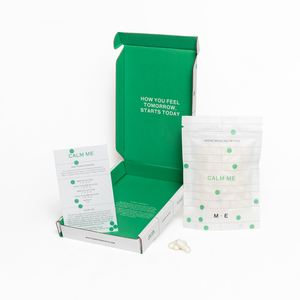
And if you want to make that nutritional support part of your daily routine, Calm Me brings several of these nutrients together in one brain-health formulation.

What Is GABA?
GABA stands for gamma-aminobutyric acid.
It is a neurotransmitter. This is a chemical messenger used by the nervous system and it is the main inhibitory neurotransmitter in the mammalian brain.
Think of your brain as a huge communication network.
Some neurotransmitters help increase or stimulate neural activity.
GABA helps provide the opposing influence: it reduces the likelihood that certain nerve cells will become overactive.
That's why GABA is often described as one of the brain's braking systems.
It doesn't mean that GABA simply switches your brain off.
Rather, healthy brain function depends on a carefully regulated balance between excitatory and inhibitory signalling.
GABA is an important part of that balance.
And that balance matters when we're talking about stress, relaxation, sleep and emotional regulation.
What Does GABA Do?
GABA signalling is involved in several important aspects of nervous-system function.
Research links GABAergic signalling with:
-
Nervous-system inhibition
-
Regulation of brain activity
-
Stress responses
-
Sleep and sleep regulation
-
Emotional processing
-
Anxiety-related brain pathways
-
Muscle and neurological function
This is why GABA has become such an interesting area of research around stress, anxiety and sleep.
However, it's important to separate the biology from the marketing.
GABA is involved in these processes.
That doesn't mean that taking GABA automatically treats anxiety, insomnia or another health condition.
The evidence is more nuanced than that.
For example, a systematic review of human trials found that evidence for oral GABA supplementation and stress was limited. More research is needed.
So rather than thinking:
"I have these symptoms, therefore I have low GABA."
A better question is:
"What can I do to support the systems involved in calm, relaxation and healthy sleep?"
That's where your toolkit comes in.

What Are the Symptoms of Low GABA?
There isn't a reliable symptom checklist that can tell you that you have a GABA deficiency.
Many experiences sometimes associated with altered GABA signalling are also common consequences of chronic stress, poor sleep, hormonal changes, nutritional insufficiency and other physical or psychological factors.
You may recognise some of these experiences:
Feeling constantly on edge
You can't quite relax, even when nothing particularly stressful is happening.
Racing thoughts
Your body may be tired but your mind keeps running.
You replay conversations.
Make lists.
Think about tomorrow.
Then think about everything you forgot to think about.
Feeling overwhelmed
Small things can suddenly feel like big things.
Your capacity feels lower than it used to be.
Being "tired but wired"
This is one of the most recognisable descriptions of nervous-system overload.
You desperately want to rest — but your brain doesn't seem to have received the memo.
Difficulty switching off at night
You may feel physically exhausted but struggle to transition into sleep.
Restless or unsettled sleep
You may fall asleep but wake frequently, sleep lightly or wake feeling as though you haven't properly recovered.
Irritability
When your nervous system is under pressure, your emotional bandwidth can become smaller.
Things that normally wouldn't bother you suddenly do.
Difficulty concentrating
When your brain is preoccupied with monitoring, worrying or responding to stress, concentration can become harder.
Physical tension
Stress and arousal can also show up physically — tense muscles, headaches, jaw tension or a general sense that your body is braced.
These experiences are real.
But they don't tell you exactly why they're happening.
That's why supporting the whole system is more useful than trying to chase one neurotransmitter.
Why Stress and GABA Are Connected
Your stress response is designed to protect you.
When your brain detects a threat, your body can move into a state of increased alertness.
Heart rate changes.
Attention narrows.
Muscles prepare for action.
Stress hormones rise.
This is incredibly useful when you actually need to respond to something.
The problem is what happens when your nervous system doesn't get enough opportunities to come back down.
Modern life can create a strange situation where the emergency is over — but your body is still behaving as though it needs to be ready for the next one.
Work.
Emails.
Notifications.
Family responsibilities.
Financial pressure.
Hormonal changes.
Poor sleep.
Too much caffeine.
Not enough movement.
Too little daylight.
The list goes on.
GABA is one of the systems involved in balancing neural excitation and inhibition, which is why researchers are interested in its role in stress and anxiety-related brain pathways.
But rather than thinking of your brain as having one "stress chemical" that needs fixing, it is more useful to think in terms of regulation and balance.
Can You Test Your GABA Levels?
This is an important question.
Not in the simple way that you might test vitamin D, iron or B12.
You cannot reliably diagnose a "GABA deficiency" simply by looking at symptoms.
GABA is a neurotransmitter operating within complex neural networks, and measuring neurotransmitter levels in an easily accessible sample does not give you a straightforward picture of what is happening throughout the brain.
So be cautious of companies offering simple neurotransmitter tests that claim to tell you exactly which neurotransmitters are "low".
Your symptoms are worth paying attention to.
But they need to be considered in context.
If you are experiencing persistent anxiety, depression, panic, severe insomnia or other significant symptoms, speak to an appropriately qualified healthcare professional rather than trying to self-diagnose a neurotransmitter imbalance.

Your GABA & Nervous-System Toolkit
The most useful approach isn't to obsess over GABA.
It's to create the conditions in which your nervous system can regulate properly.
Here are five places to start.
1. Move Your Body
Exercise is one of the most powerful tools we have for supporting brain health.
Regular movement is associated with improvements in mood, stress regulation, sleep and cognitive health.
It doesn't have to mean an intense workout.
A brisk walk.
Cycling.
Swimming.
Dancing in your kitchen.
Strength training.
Yoga.
Even a short walk outside can become a useful transition between "work mode" and "home mode".
And there is specific research looking at exercise, yoga and GABA signalling.
The goal isn't to exercise yourself into exhaustion.
It's to give your nervous system a regular opportunity to experience movement, recovery and regulation.
2. Practise the Art of Switching Off
Your nervous system needs signals of safety and recovery.
That doesn't necessarily mean sitting cross-legged in silence for 30 minutes.
Your version of relaxation might be:
-
Walking
-
Reading
-
Gardening
-
Cooking
-
Listening to music
-
Drawing
-
Yoga
-
Meditation
-
Stretching
-
Sitting outside
-
Spending time with people who make you feel safe
-
Doing something purely because you enjoy it
The important thing is that you deliberately create periods where your brain isn't required to perform, solve, respond or produce.
Rest is not wasted time.
It is part of the rhythm of a healthy nervous system.
3. Support Your Brain With the Right Nutrients
Your brain needs nutrients to maintain normal nervous-system function.
Several nutrients are particularly relevant here.
Magnesium
Magnesium contributes to normal nervous-system function and normal psychological function.
It is found in foods including nuts, seeds, legumes and whole grains.
Vitamin B6
Vitamin B6 contributes to normal psychological function and normal nervous-system function.
It is also involved in neurotransmitter metabolism.
L-Theanine
L-theanine is an amino acid naturally found in tea, particularly green tea.
Research has investigated its relationship with relaxation, stress and attention.
It is particularly interesting because it can be associated with a state of relaxed alertness rather than simply making you sleepy.
Glutamine
Glutamine is an amino acid involved in neurotransmitter metabolism.
The brain uses glutamine in the metabolic pathways involved in the production of glutamate and GABA.
This is one reason glutamine is included in formulations designed around brain and nervous-system nutrition.
Probiotics and the gut-brain connection
The relationship between the gut and the brain is an increasingly important area of research.
Certain microorganisms can produce or influence GABA-related signalling, and researchers are continuing to investigate how the gut microbiome communicates with the nervous system.
This doesn't mean that a probiotic is a treatment for anxiety or insomnia.
It does mean that gut health is increasingly relevant to the bigger picture of brain health.
4. Don't Underestimate Sleep
Sleep and stress have a two-way relationship.
Poor sleep can make you more emotionally reactive and less resilient the following day.
And stress can make it harder to switch off and sleep well.
That can create a loop:
Stress → poor sleep → reduced resilience → more stress → poorer sleep.
Rather than trying to solve sleep with one magic ingredient, build a repeatable evening routine.
Try:
-
Dimmer light in the evening
-
Less screen stimulation before bed
-
A consistent bedtime
-
A cooler, darker bedroom
-
Gentle movement
-
Reading
-
Relaxing music
-
Slow breathing
-
Limiting caffeine later in the day
-
Giving yourself enough time to sleep
Your brain likes rhythms.
Consistency matters.
5. Give Your Nervous System More "Safe" Signals
This is where your everyday environment becomes part of your brain-health toolkit.
Daylight.
Nature.
Movement.
Breathing.
Music.
Laughter.
Connection.
Touch.
Food.
Sleep.
Pleasure.
These aren't separate from brain health.
They are inputs into the system.
You don't have to completely redesign your life.
Start with one small change.
A morning walk.
A few slow breaths before opening your emails.
A proper lunch away from your desk.
Ten minutes outside.
Music while you cook.
A phone-free evening.
Small signals, repeated consistently, can become powerful habits.

Can Supplements Support GABA?
This is where it's important to be specific.
A supplement cannot "fix" your nervous system.
And you should be wary of any product promising to cure anxiety, depression, insomnia or a supposed neurotransmitter deficiency.
What nutritional support can do is provide nutrients that contribute to normal nervous-system and psychological function.
That's the philosophy behind Calm Me.
Calm Me was formulated around the nutritional pathways involved in calm, relaxation, nervous-system function and sleep.
It combines:
-
L-Glutamine — 600mg
-
L-Theanine — 200mg
-
Three forms of magnesium
-
Vitamin B6
-
Vitamin D3
-
Glycine
-
Taurine
-
A probiotic blend
-
MoodNutritionPlus®, containing L-tryptophan, L-tyrosine, L-glutamine and L-carnitine
The formulation is designed to provide targeted nutritional support rather than relying on a single ingredient.
That's important because your brain doesn't use nutrients in isolation.
They work within interconnected metabolic and neurological pathways.
Calm Me is designed for the days when your mind is racing, you're feeling overwhelmed, you can't switch off or your sleep isn't as restorative as you'd like it to be.

Calm Me: Nutritional Support for Calm + Sleep
Calm Me contains 18+ targeted nutrients, including magnesium, L-theanine, L-glutamine, B6, vitamin D3, amino acids and probiotics.
It is:
-
Vegan
-
Gluten-free
-
Made in Britain
-
Active ingredients only
-
Free from fillers and additives
-
Designed by a psychologist
-
Formulated around brain, mood, calm and sleep nutrition
It is intended to complement, not replace, a healthy diet and lifestyle.
And because everyone's circumstances are different, if you take medication, have a medical condition, are pregnant or breastfeeding, speak to your doctor or pharmacist before using a supplement.
Calm Me Has Been Independently Recognised for Sleep
We are particularly proud that Calm Me has received independent recognition for its formulation and its focus on sleep and recovery.
2024 — Red's Better Perimenopause Awards
Best for Sleep
Calm Me was selected as Best for Sleep in Red's Better Perimenopause Awards.
2025 — Nourish Awards
3-Star — Sleep & Recovery
Calm Me received 3-star recognition in the Sleep & Recovery category at the 2025 Nourish Awards.
2026 — Nourish Awards
2-Star Nourish Excellence — Sleep & Recovery
Calm Me was recognised again in 2026, receiving 2-star Nourish Excellence in Sleep & Recovery.
Awards aren't clinical trials and they cannot guarantee an individual result.
What they do provide is another piece of information when you're evaluating a formulation, particularly when the judging process considers areas such as formulation quality, active ingredients, bioavailability, dosing, synergy, scientific testing and overall product quality.
For us, that's what makes independent recognition meaningful.
Not because an award tells you how you will feel.
But because it gives you another reason to look more closely at what is actually inside the product.
Your GABA Toolkit: Start Small
You don't need to do everything.
Choose one thing from each category.
MORNING
☀️ Get outside into daylight.
💧 Hydrate before your first caffeine.
🥚 Eat a protein-rich breakfast.
DAY
🚶 Move your body.
🌿 Get outside.
🥗 Eat a varied, nutrient-rich diet.
EVENING
📵 Reduce stimulation.
😮💨 Try slow breathing.
🎵 Put on music that helps you unwind.
📖 Read instead of scrolling.
EVERY DAY
❤️ Connect with people.
😂 Laugh.
🌱 Spend time in nature.
😴 Protect your sleep.
💊 Consider whether targeted nutritional support could help fill nutritional gaps in your routine.

The Bigger Picture
Your brain isn't a machine that needs fixing.
It's an incredibly adaptable biological system responding to everything you repeatedly give it.
Food.
Movement.
Light.
Sleep.
Stress.
Connection.
Thoughts.
Environment.
Nutrients.
Habits.
The aim isn't to create a perfectly calm life.
That's impossible.
The aim is to build a nervous system that has opportunities to activate, recover and regulate.
So if you're feeling wired but tired, overwhelmed, restless or unable to switch off, don't immediately assume something is wrong with you.
Start by asking:
What is my nervous system being asked to deal with every day?
And then ask:
What can I give it more of?
More daylight.
More movement.
More nourishment.
More rest.
More connection.
More recovery.
More consistency.
Because sometimes the most powerful changes aren't dramatic.
They're the small things you repeat.
How you feel tomorrow starts today.
Frequently Asked Questions About GABA
What is GABA?
GABA, or gamma-aminobutyric acid, is the main inhibitory neurotransmitter in the mammalian brain. It helps regulate neural activity and plays an important role in the balance between excitatory and inhibitory signalling.
What are the symptoms of low GABA?
There is no reliable symptom checklist that can diagnose low GABA. Experiences sometimes associated with altered GABA signalling include feeling on edge, racing thoughts, difficulty relaxing, sleep difficulties, irritability and feeling overwhelmed. However, these symptoms have many possible causes.
Can stress affect GABA?
Research suggests that stress can influence GABAergic signalling and the balance between excitatory and inhibitory neurotransmission. This is one reason GABA is being studied in relation to stress, anxiety and emotional regulation.
How can I increase GABA naturally?
Rather than focusing on one neurotransmitter, support overall nervous-system health through regular movement, sufficient sleep, relaxation practices, a varied nutrient-rich diet, social connection and stress-management habits.
Which nutrients support normal nervous-system function?
Magnesium and vitamin B6 both contribute to normal nervous-system function. Other nutrients, including amino acids such as L-theanine and glutamine, are involved in pathways relevant to brain and neurotransmitter function.
Does GABA help with sleep?
GABA is involved in sleep regulation, but evidence for taking GABA orally as a supplement is still limited. A systematic review found limited evidence for stress benefits and very limited evidence for sleep benefits from oral GABA. More research is needed.
Is Calm Me a GABA supplement?
Calm Me does not simply provide GABA. It is a broader nutritional formulation containing ingredients including L-glutamine, L-theanine, magnesium, vitamin B6, glycine, taurine, vitamin D3 and probiotics, designed to support normal nervous-system function, calm and sleep.
Can I take Calm Me with medication?
If you take medication, have a medical condition, are pregnant or breastfeeding, check with your doctor or pharmacist before taking Calm Me.
Research & Further Reading
GABA and stress and sleep
Hepsomali et al. (2020), Effects of Oral Gamma-Aminobutyric Acid (GABA) Administration on Stress and Sleep in Humans: A Systematic Review.
GABA, anxiety and insomnia
Jiang, Chen & Sun (2025), From the gut to the brain: mechanisms and clinical applications of γ-aminobutyric acid (GABA) on the treatment of anxiety and insomnia.
GABA and anxiety-related pathways
GABAB Receptors: Anxiety and Mood Disorders.
GABA and brain function
Insights and progress on the biosynthesis, metabolism, and physiological functions of gamma-aminobutyric acid: a review.
Yoga, mood and GABA
Effects of Yoga Versus Walking on Mood, Anxiety, and Brain GABA Levels.
Stress and prefrontal GABA
Effect of Acute Psychological Stress on Prefrontal GABA Concentration.
Calm Me Awards & Recognition
2024 — Red's Better Perimenopause Awards Red's Better Perimenopause Awards
Best for Sleep
2025 — Nourish Awards 2025 2025 Nourish Awards Yearbook
3-Star — Sleep & Recovery
2026 — Nourish Awards 2026 Nourish Awards Winners
2-Star Nourish Excellence — Sleep & Recovery
Awards are independent recognitions and should not be interpreted as evidence that a supplement can diagnose, treat or cure a medical condition. Individual responses to supplements vary.
A NOTE FROM MONTGOMERY + EVELYN
We believe supplements should never be about making bigger promises.
They should be about understanding the body, understanding the nutrients and creating thoughtful formulations that make sense.
Look at the ingredients.
Look at the amounts.
Look at the research.
Ask questions.
And build the habits around your supplements that support the brain you want to live in.
Small habits. Big changes.
How you feel tomorrow starts today.
Links
Calm Me: Calm Me — Montgomery + Evelyn
2025 Nourish Awards: 2025 Nourish Awards Yearbook
2026 Nourish Awards: 2026 Nourish Awards Winners
Red's Better Perimenopause Awards: Red's Better Perimenopause Awards
Research links
PubMed — GABA, stress and sleep systematic review
For the newer gut-brain/GABA angle: PubMed — GABA, anxiety, insomnia and the gut-brain axis
For the underlying GABA biology: PubMed — GABA biosynthesis, metabolism and physiological functions
Anxiety disorders and GABA neurotransmission: a disturbance of modulation
https://www.ncbi.nlm.nih.gov/pmc/articles/PMC4303399/
Effects of Yoga Versus Walking on Mood, Anxiety, and Brain GABA Levels
https://www.ncbi.nlm.nih.gov/pmc/articles/PMC3111147/
Effect of Acute Psychological Stress on Prefrontal GABA Concentration
https://www.ncbi.nlm.nih.gov/pmc/articles/PMC3107037/
Sleep
https://pubmed.ncbi.nlm.nih.gov/19014069/
The Impact of Glutamine supplementation
https://molecularneurodegeneration.biomedcentral.com/articles/10.1186/s13024-016-0127-y
Glutamine increases GABA
https://pubmed.ncbi.nlm.nih.gov/17218538/
The effects of Magnesium on stress
https://www.ncbi.nlm.nih.gov/pmc/articles/PMC5452159/
Long term stress reduction with magnesium
https://pubmed.ncbi.nlm.nih.gov/27933574/
Nutritional and herbal supplements for anxiety and anxiety-related disorders: systematic review
https://www.ncbi.nlm.nih.gov/pmc/articles/PMC2959081/
Vitamin B6
https://link.springer.com/referenceworkentry/10.1007%2F978-3-319-40007-5_81-1
Psychobiotics and the Manipulation of Bacteria–Gut–Brain Signals
https://www.ncbi.nlm.nih.gov/pmc/articles/PMC5102282/
Probiotics and GABA
https://www.sciencedirect.com/science/article/pii/S1756464619305936
The Influence of Micronutrients on cognitive Function and Performance
https://journals.sagepub.com/doi/pdf/10.1177/147323000703500101
Ingestion of Lactobacillus strain regulates emotional behavior and central GABA receptor expression in a mouse via the vagus nerve
https://www.pnas.org/doi/10.1073/pnas.1102999108
Stress in Regulation of GABA Amygdala System and Relevance to Neuropsychiatric Diseases
https://www.frontiersin.org/articles/10.3389/fnins.2018.00562/full
Anxiety disorders and GABA neurotransmission: a disturbance of modulation
https://www.ncbi.nlm.nih.gov/pmc/articles/PMC4303399/
Effects of Yoga Versus Walking on Mood, Anxiety, and Brain GABA Levels
https://www.ncbi.nlm.nih.gov/pmc/articles/PMC3111147/
Effect of Acute Psychological Stress on Prefrontal GABA Concentration
https://www.ncbi.nlm.nih.gov/pmc/articles/PMC3107037/
Sleep
https://pubmed.ncbi.nlm.nih.gov/19014069/
The Impact of Glutamine supplementation
https://molecularneurodegeneration.biomedcentral.com/articles/10.1186/s13024-016-0127-y
Glutamine increases GABA
https://pubmed.ncbi.nlm.nih.gov/17218538/
The effects of Magnesium on stress
https://www.ncbi.nlm.nih.gov/pmc/articles/PMC5452159/
Long term stress reduction with magnesium
https://pubmed.ncbi.nlm.nih.gov/27933574/
Nutritional and herbal supplements for anxiety and anxiety-related disorders: systematic review
https://www.ncbi.nlm.nih.gov/pmc/articles/PMC2959081/
Vitamin B6
https://link.springer.com/referenceworkentry/10.1007%2F978-3-319-40007-5_81-1
Psychobiotics and the Manipulation of Bacteria–Gut–Brain Signals
https://www.ncbi.nlm.nih.gov/pmc/articles/PMC5102282/
Probiotics and GABA
https://www.sciencedirect.com/science/article/pii/S1756464619305936
The Influence of Micronutrients on cognitive Function and Performance
https://journals.sagepub.com/doi/pdf/10.1177/147323000703500101
Ingestion of Lactobacillus strain regulates emotional behavior and central GABA receptor expression in a mouse via the vagus nerve
https://www.pnas.org/doi/10.1073/pnas.1102999108
Stress in Regulation of GABA Amygdala System and Relevance to Neuropsychiatric Diseases
https://www.frontiersin.org/articles/10.3389/fnins.2018.00562/full
As featured in this story

Written by Evelyn Montgomery


Leave a comment
This site is protected by hCaptcha and the hCaptcha Privacy Policy and Terms of Service apply.